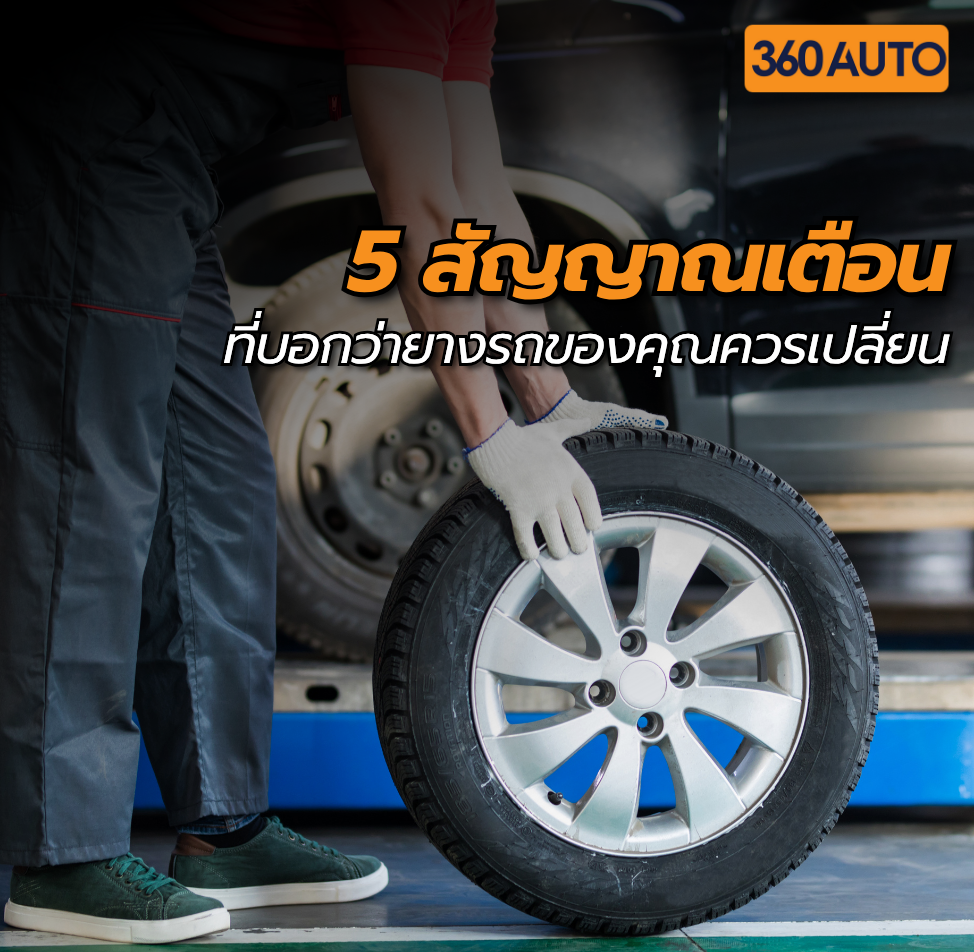
Why Changing Tires Matters
Your tires are the only part of the car that touches the road.
When they’re worn or aged, they lose traction, reduce braking performance, and increase the risk of accidents — especially on wet roads or during sudden stops.
Knowing “when to replace your tires” is essential for every car owner to ensure both safety and long-term savings.
🔹 1. Worn or Shallow Tread
One of the most visible signs is low tread depth — when the grooves are shallower than 1.6 mm, the minimum safety standard.
How to check:
-
Insert a Thai 1-baht coin (or any small coin) into the tread groove.
If you can clearly see the number “1,” your tread is too shallow. -
Look for the Tread Wear Indicator (TWI) — a small rubber bar inside the groove.
If the tread surface is level with the indicator, it’s time to replace your tires immediately.
🔹 2. Cracks on the Sidewall
If you notice small cracks or “crazing lines” along the tire’s sidewall, that’s a sign of aging or UV damage — and it could lead to a tire blowout while driving.
Common causes:
-
Frequent exposure to sunlight
-
Heat buildup
-
Tire age exceeding 4–5 years
🔹 3. Vibration or Unusual Noise
If your car starts vibrating even on smooth roads, or you hear strange “whirring” or “thumping” noises from the tires, it could mean the tire is unbalanced or has a bulge.
What to do:
-
Get a wheel alignment and balance check.
-
If any tire is bulging or deformed, replace it immediately — it’s a serious blowout risk.
🔹 4. Tires Older Than 5 Years
Even if your tires still look fine, once they’ve been used for over 5 years, the rubber hardens and traction decreases — especially on wet or curved roads.
How to check tire age:
-
Look for a 4-digit DOT code on the sidewall, e.g.,
2220= manufactured in week 22 of 2020. -
If it’s been over 5 years since that date, it’s time to replace them for safety.
🔹 5. Longer Braking Distance or Increased Fuel Consumption
If your car takes longer to stop or seems to use more fuel than usual, worn tires could be the cause.
When traction drops, the tires create more drag — resulting in:
-
Higher fuel usage
-
Longer braking distance → higher accident risk
🔧 What to Do When You Notice These Signs
-
Inspect your tires every 3 months or every 10,000 km
-
Rotate tires as recommended by your service center
-
If any of the above symptoms appear, replace your tires immediately at a trusted shop
💡 Tips for Choosing New Tires
-
Match the tire size with your car’s specifications
-
Choose based on your driving style:
-
City driving: Comfort tires (e.g. Bridgestone Turanza, Michelin Primacy)
-
Long-distance driving: Tires with good grip and fuel efficiency
-
-
Check user reviews before making your purchase
🛒 Replace Your Tires with Confidence at 360auto.online
At 360auto.online, you can shop a wide selection of top global brands like Bridgestone, Michelin, Yokohama, Hankook, and Continental — with nationwide installation service near your home.
All-in-one benefits:
-
120-day damage warranty (cut, puncture, or burst)
-
5-year manufacturer warranty
-
0% installment up to 6 months
🔚 Summary: When Should You Replace Your Tires?
If your tires show any of these 5 warning signs,
👉 it’s time to get new ones — for your safety and peace of mind.
Don’t wait until your tires fail.
Because good tires are the foundation of safe driving on every road.